
IT Tips & Tricks
Stargate: The $500 Billion AI Bet to Create a Wildly Different World
Published 16 December 2025
Unless you’re from a galaxy far, far away, you’ve likely heard or seen some of the latest breakthroughs in AI: the chatbots that can write a novel, the tools that generate hyper-realistic video and the systems that are fundamentally changing how we search for information. But behind every lightning-fast response from a cutting-edge AI model lies a physical, tangible resource far more essential than code — massive computing infrastructure.
Right now, the AI industry is facing a crisis. Demand for the compute power required to train the next generation of truly advanced AI models — what many call Artificial General Intelligence (AGI) — is outpacing the world’s ability to build the necessary data centers.
This is where the Stargate Project comes in.
Demand for the compute power is outpacing the world’s ability to build the necessary data centers.
AI vs AGI: The Next Frontier
What’s the difference between AI and AGI? AI is an umbrella term for any machine that mimics human cognitive functions such as learning, problem-solving and decision-making.
However, AI experts consider the AI we currently use to be narrow or weak. Achieving AGI, on the other hand, is considered by many researchers to be the single most important technological breakthrough of the 21st century.
Characteristics of Current AI
Looking at where we started and where we’re headed, “exponential” is at the heart of the matter.
- Goal-Oriented and Specific: Current AI is designed and trained to perform a single, narrowly defined task or set of tasks very well.
Examples include recommending a product (Amazon), recognizing a face (Apple’s Face ID), driving a car (Tesla’s Autopilot) or responding to textual prompts as a general-purpose reasoning and language model (ChatGPT).
- Data-Dependent: It excels only within the domain of the data it was trained on. A language model, for instance, cannot suddenly become an expert medical diagnostician without a completely new training phase on medical data.
- Non-Transferable Skills: It cannot readily take the knowledge learned in one domain and apply it to a completely different, unrelated domain. A chess-playing AI cannot suddenly start writing poetry.
- The “Illusion of Intelligence”: While impressive, current AI systems achieve human-like results through statistical pattern recognition and massive data sets, not through true understanding, actual reasoning, nor common sense. And we all know those moments when AI gets it wrong with either frustrating or hilarious results.

Not sure whether six arms would be helpful or a hindrance. And two tails? Really, AI?
The Goal of AGI
Characteristics of AGI
- Versatility and General Knowledge: AGI can handle any intellectual task and switch domains effortlessly, much like a human. It can learn algebra in the morning, apply that abstract reasoning to an architectural design problem in the afternoon and write you romantic poetry by night.
- Abstract Reasoning and Common Sense: It would possess common sense, self-awareness, critical thinking and the ability to perform complex, abstract reasoning without being explicitly programmed or trained on every specific scenario.
- Transfer Learning: AGI can transfer knowledge and skills across domains. Learning how to navigate a virtual environment, for example, could help it learn how to navigate a physical environment.
The goal for AGI is essentially an AI with human-level intelligence across a range of tasks. The goal of the Stargate Project is specifically to build facilities that can provide the raw processing power needed to attain AGI.
Why Half a Trillion Dollars Is the New Baseline
The Stargate Project is not a government program, nor is it science fiction. It is a real, large-scale private initiative — formally organized as Stargate LLC — that represents the boldest attempt yet to solve the AI compute bottleneck. The objective is to build a foundation so large that it can sustain the unprecedented demands of future AI, the above-mentioned AGI.
AGI is what we see in science fiction. It would be the machine equivalent of a fully functioning human mind (at least in theory).
The numbers are staggering, positioning Stargate as a major investment in the infrastructure of the 21st century.
- Investment Goal: Up to $500 billion is slated for investment in US AI infrastructure over four years (2025–2029).
- Initial Commitment: The project officially launched in early 2025 with an immediate deployment of $100 billion to secure early hardware and construction.
- Power Target: The goal is to build facilities capable of delivering a staggering 10 gigawatts (GW) of compute capacity.
To put 10 gigawatts into perspective, that’s roughly the power output of several large nuclear power plants — combined — or enough electricity to power multiple major US metropolitan areas. This scale completely redefines “hyperscale” data centers.
Note: In case you are wondering, that’s nearly ten times the 1.21 gigawatts the DeLorean time machine allegedly required to power the flux capacitor in the movie Back to the Future.
The “Why” of the Compute Crisis: Scaling Laws
Why is this half-trillion-dollar bet necessary? The answer lies in the scaling laws of modern deep learning. Scaling laws provide a mathematical framework that allows researchers to forecast how much better a model will perform if they increase its size, the amount of data it’s trained on or the computational budget.
- Since the introduction of the Transformer architecture (the engine behind AI models like GPT and Gemini), researchers have observed a predictable, exponential relationship between three factors: the size of the model (parameters), the amount of training data (measured in tokens) and the overall compute budget, measured in FLOPS (Floating Point Operations) and Graphics Processing Unit- or GPU-hours.
In simple terms, bigger, better AI requires bigger, better computation.
The word “exponential” comes to mind, and looking at where we started and where we’re headed, “exponential” is at the heart of the matter.
These new mega-sites are not just physical hubs. They’re becoming AI talent clusters.
- According to various reports, the first AI transformer (a neural network used for language tasks such as understanding the context and relationships between different parts of input data) created by Google in 2017 cost $930 to train. (Yeah, I too am surprised that the cost was that low and I suspect that overhead costs are not included in that figure. Nonetheless, even if the full cost were ten times that much, it’s still a pittance compared with what soon followed.)
- Training its successor, GPT-3 (175 billion parameters), cost an estimated $4.6 million in compute.
- The training cost for the next leap, GPT-4 (rumored to have 1.8 trillion parameters), shot up to a figure stated by OpenAI’s CEO, Sam Altman, to be over $100 million, even with efficiency improvements.
This trajectory means that developing AGI will demand compute resources that simply do not exist in the current global cloud network. Stargate is essentially an attempt to manufacture that capacity in a massive, dedicated cluster.
The Corporate Titans Behind the Project
Stargate is a joint venture bringing together some of the world’s most influential tech and finance heavyweights, each playing a critical role.
| Partner | Primary Role | Strategic Contribution |
| OpenAI | Lead Operational Partner | Drives the massive demand for compute and defines the infrastructure requirements needed to train frontier models. |
| SoftBank Group | Lead Financial Partner | Provides the primary financial backing for the hundreds of billions of dollars required for construction and hardware procurement. |
| Oracle Corporation | Infrastructure Partner | Provides the cloud environment (Oracle Cloud Infrastructure — or OCI — Supercluster) and operational systems, relying on its global network and bare-metal performance expertise. |
| NVIDIA | Core Technology Partner | Supplies the vast number of GPUs and accelerators that form the processing core of the system. |
| Microsoft | Strategic Technology Partner | Continues its close partnership with OpenAI, leveraging the Azure cloud and technology while benefiting from the Stargate-built capacity. |
The Operational Model: Purpose-Built AI Clusters
One of Stargate’s most strategic advantages is its departure from the general-purpose cloud model. Instead of sharing capacity across millions of customers running different workloads, Stargate is building a dedicated, purpose-built cloud for AI — the OCI Supercluster.
The OCI Supercluster Advantage
Traditional cloud environments involve overhead like hypervisors (virtualization layers) that can slow down the communication between thousands of GPUs. The Stargate architecture, primarily delivered via OCI, eliminates this.
In immersion cooling, entire racks of servers are submerged in specialized, non-conductive dielectric fluids.
- Bare Metal Performance: The OCI Supercluster uses bare metal GPU instances, meaning the hardware is dedicated to a single tenant without the performance drag of virtualization.
- Ultra-Low Latency Networking: The key to training giant models is the speed at which thousands of GPUs can talk to each other. OCI uses custom-designed RDMA (Remote Direct Memory Access) networking, delivering ultra-low latency cluster networking. This allows the model training to be split across hundreds of thousands of GPUs without the system bottlenecking on data transfer. For a model with 1.8 trillion parameters, every fraction of a microsecond saved on communication translates to weeks saved on a multi-month training run.
- Massive Scale: The architecture is designed to support up to 131,072 GPUs in a single, interconnected cluster, a scale far exceeding most current enterprise cloud deployments.
The Engineering Challenge: Power, Water and Heat
The $500 billion investment isn’t just for chips. A significant portion is allocated to solving the gargantuan engineering problems created by the 10-gigawatt requirement.
The Power Problem
The move from general-purpose Central Processing Units (CPUs) to power-hungry, high-density GPUs has fundamentally changed data center design. A single, advanced AI GPU can draw 700 watts (or more) and a densely packed rack of these cards can exceed 50 kilowatts (kW) — an order of magnitude higher than conventional racks.
The 10-gigawatt goal requires not just securing enough energy from the grid, but in many cases, necessitates the development of new, dedicated power generation and transmission infrastructure. This means partnering with utility companies on a massive scale to prevent destabilizing local power grids in the chosen locations.
The Cooling Crisis
Almost all the power consumed by a data center is eventually converted into waste heat. In the age of gigawatt-scale computing, air cooling is rapidly becoming obsolete.
To manage the extreme heat generated by dense GPU clusters, the Stargate team is deploying advanced cooling strategies:
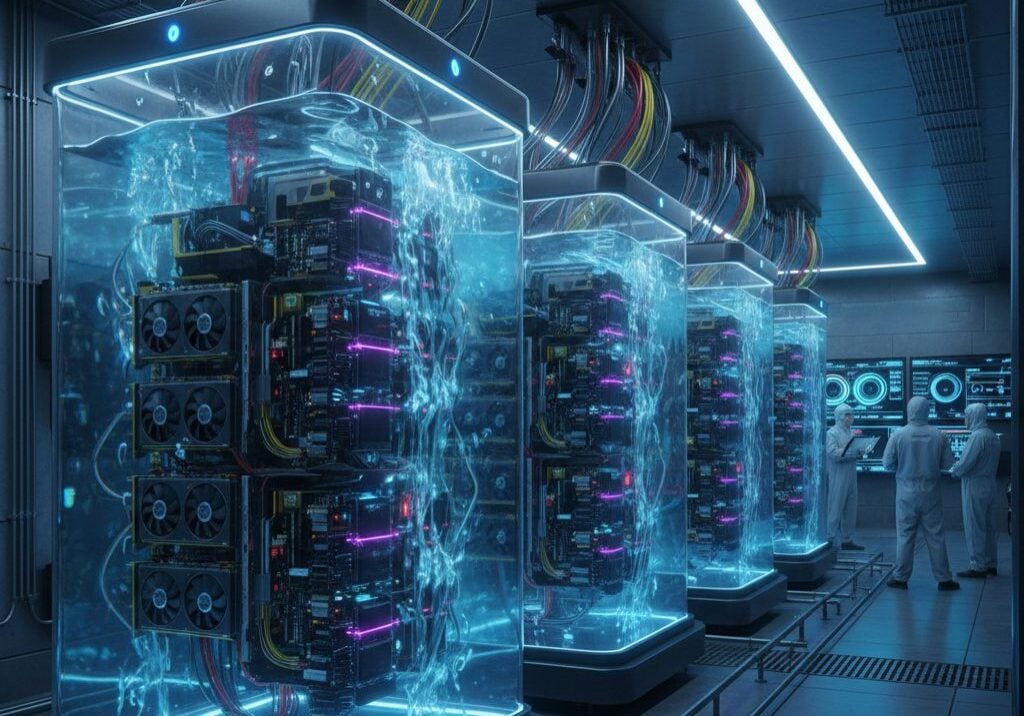
An AI take on immersion-cooled GPUs.
- Direct-to-Chip Liquid Cooling: Chilled water or other coolant is piped directly to a cold plate on top of the GPU, absorbing heat before it can enter the room air. This is significantly more efficient than air cooling.
- Immersion Cooling: Entire racks of servers are submerged in special non-conductive dielectric fluids. This method, while complex to set up, offers the highest thermal capacity and efficiency, potentially cooling up to 5 kW per server socket, creating thermal balance.
In the arid regions of Texas and New Mexico, the Stargate Project’s design focuses on drastically reducing Water Usage Effectiveness (WUE) to near zero to avoid reliance on continuous natural water sources.
The up-and-running flagship site in Abilene, Texas, uses a closed-loop cooling system and required a one-time initial eight-million-gallon fill from the Abilene municipal water supply, which was minimal compared to the city of Abilene’s average daily use.
The system continuously recirculates the cooling fluid. Ongoing water use is minimal — primarily for topping up minor losses from maintenance — and is described as equivalent to the domestic needs of a large office building.

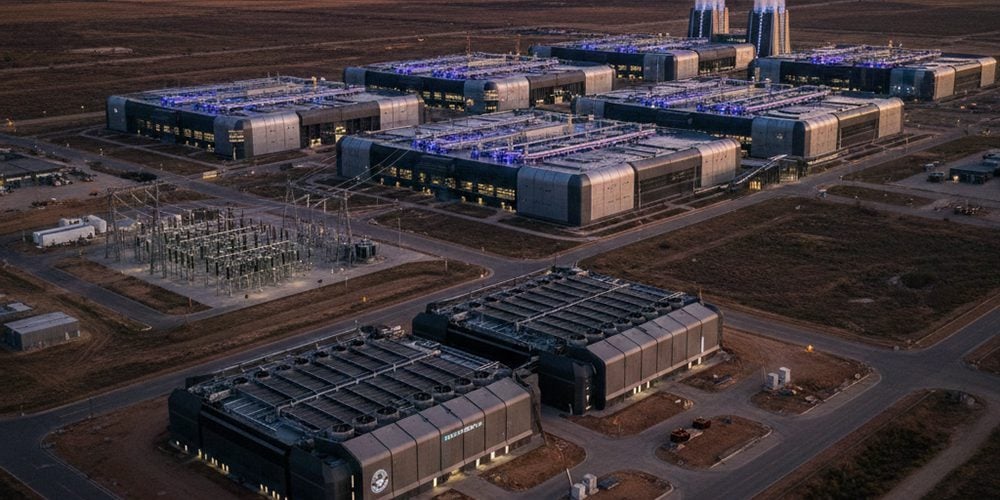
West of Dallas, Texas, lies Abilene, home to around 130,000 residents — and the 875-acre flagship Stargate Project site.
Future locations in Texas and New Mexico are dedicated to the same water-wise closed-loop cooling.
The Midwest is generally considered water-rich due to its higher rainfall than the Southwest, its proximity to the Great Lakes and access to other inland water sources. However, the proposed Stargate locations in Ohio and Michigan will still need to ensure that municipal water supplies can handle the one-time fill demand for their proposed closed-loop cooling systems. Once operational, a strategy of maintaining extreme water efficiency to minimize consumption will also be a necessity.
Geopolitics, Talent and the Road to AGI
While non-political, the Stargate Project is a decisive geopolitical move. By committing to such a large, domestically located infrastructure, the partners are strategically consolidating the means of AI production within the US. This insulates them from international supply chain disruptions and secures their access to the most advanced chips.
Furthermore, these new mega-sites are not just physical hubs. They’re becoming AI talent clusters. The sheer scale and exclusivity of the hardware attract the world’s top AI researchers and engineers, creating regional clusters of advanced research and innovation.
The Stargate Project is, above all, a bet on the future intelligence of its machines. If the scaling laws — laws that describe the relationship between the performance of a large neural network and the key resources used to train it — hold true, the massive infrastructure being built today is not just about making current models slightly better. It is the fundamental building block for achieving AGI — a project of historical significance that could define the rest of the 21st century.
And with infinite capability comes infinite outcomes …
By Ed Clark

Nobody knows what the future holds, but, for better or worse, the Stargate Project aims to give us Artificial General Intelligence. Game-changer or downfall? You be the judge.

Ed Clark
LinkTek COO

Feel free to share this article on your social media:
Recent Comments
- No recent comments available.


 ChatGPT,
 Gemini,
 Claude and
 Copilot

Leave a Comment